
In 1994, the Clinton administration signed the Violent Crime Control and Law Enforcement Act. This “crime bill” was ultimately responsible for rapidly accelerating mass incarceration and the construction of for-profit prisons within the United States. In 1995, in an article in The Weekly Standard, a conservative publication founded by William “Bill” Kristol, an American neoconservative writer, and financed by none other than Rupert Murdoch, Philadelphia native, pseudo-intellectual, “Christian Democrat”, and "criminologist" John DiIulio Jr. coined the term "Superpredators" in reference to a looming generation of violent young, primarily black, boys that would be unleashed upon the nation in the next 10 years if the country did not act accordingly. DiIulio and other “intellectuals” like him appeared frequently in the news and print media, fueling an uncontrollable fire that led to the further destabilization and demonization of poor and black communities for generations to come.
DiIulio’s 1995 article is believed to be the first time the term was published.
A link to the original article can be accessed by clicking the banner below, and an example of one of DiIulio's many media appearances is also linked below


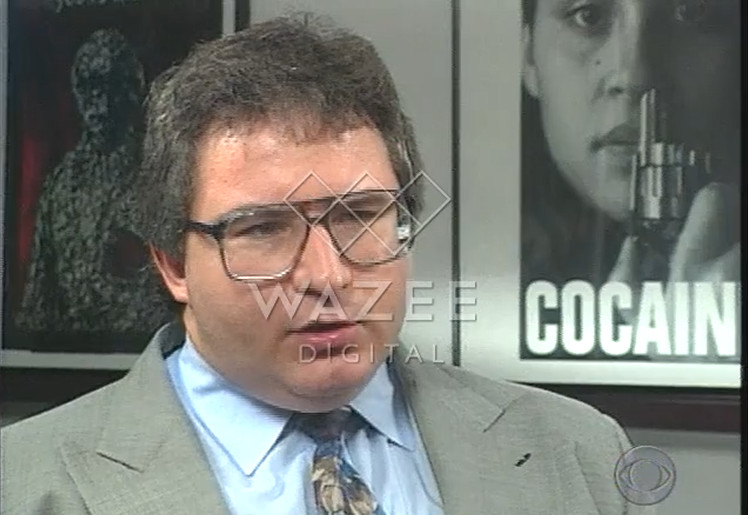
John DiIulio Jr's appearance on CBS News. 04-09-1996
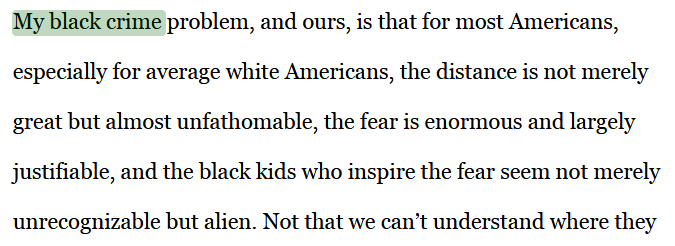
Dilulio blamed the rise of the so-called “Super-Predator” not on the economic realities and poor material conditions available to disenfranchised youth post-Reaganomics and the crack cocaine epidemic, but rather on an “abject moral poverty” that, Dilulio believed, could only be solved by converting wayward youths to Christianity or sending them behind bars. Below is an excerpt from his piece titled “My Black Crime Problem and Ours,” published in the spring 1996 edition of The City Journal, attempting to explain his backwards “rationale”.
On August 1, 1994, less than a month after the signing of the crime bill by then-President Bill Clinton, Dilulio and members of the “Project for the Republican Future”, a conservative think tank created by the aforementioned William Kristol, hosted a discussion in the Senate on the Violent Crime Control and Law Enforcement Act entitled: "Why the GOP is Right to Oppose the Crime Bill". This opposition was an attempt to morph the 94 crime bill into an even more draconian piece of legislation. The full discussion can be found via CSPAN at the link below.
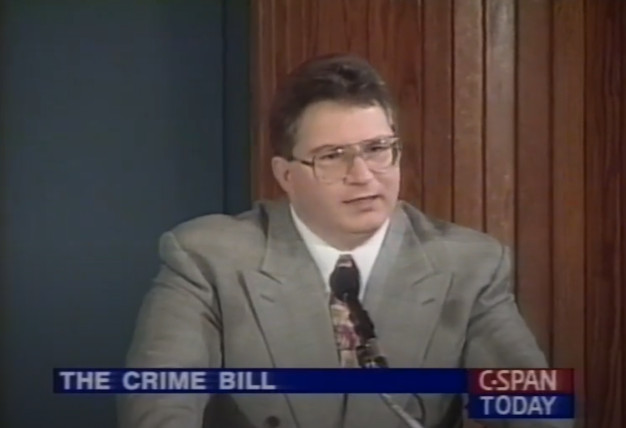
John DiIulio Jr's appearance with members of the "Project for the Republican Future" 08-08-1994
On February 14, 1995, the Senate Judiciary Committee held a hearing on Crime Control. Senate members, including then-Senator Joe Biden, who originally sponsored the bill back in 1993, heard testimony on the federal government's law enforcement priorities. House Republicans used Dilulio as “expert testimony” to justify Republican amendments to the Violent Crime Control and Law Enforcement Act. Some of which featured proposed increases in financial backing for states that achieved 85% or higher incarceration rates, increases in time served, and eliminated potential alternatives to incarceration listed in the original 1994 bill. The full diuscussion can be viewed at the link below
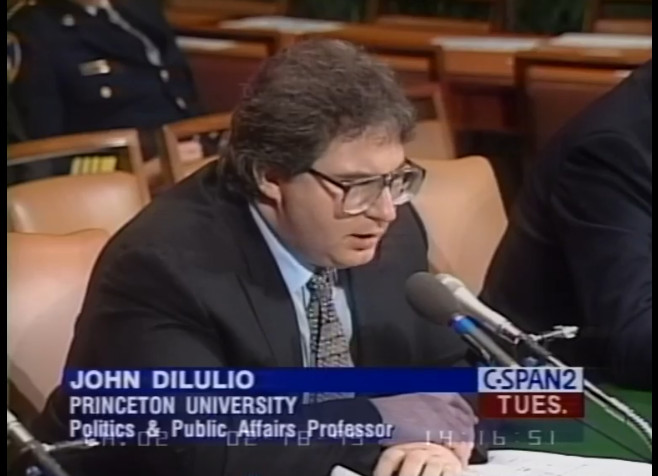
John DiIulio Jr's appearance with members of the Senate Judiciary Committee
02-14-1995
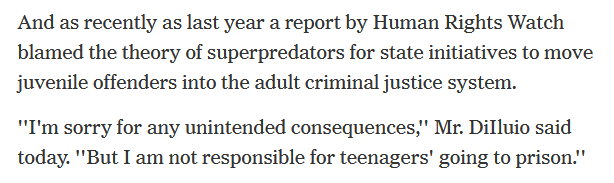
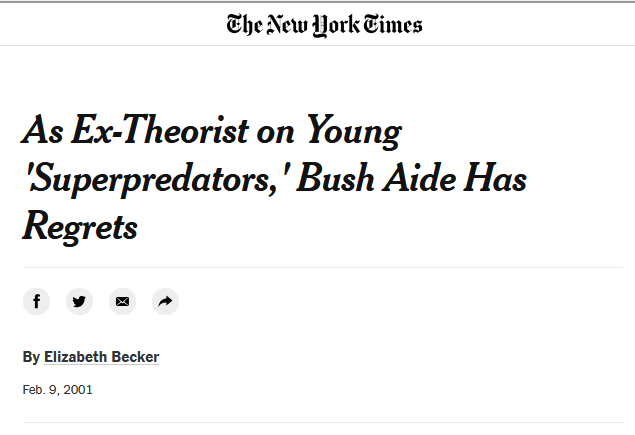
In 2001, 7 months before 9/11, and after George Bush “won” the election of 2000 a few months prior, DiIulio admitted his theory was incorrect in a New York Times article released that same year during his time as the director of the newly founded White House Office of Faith-Based and Community Initiatives under the Bush administration. An excerpt from his admission can be found below, as well as an archived link to the full article embedded in the image
Three years later, in 2004, almost a decade after the birth of the Super-predator myth. I was born.
In 2010, DiIulio received two awards, the Ira Abrams Memorial Award and the Lindback Award for Distinguished Teaching, for excellence in academics and teaching and, at the time of writing, a faculty member of the University of Pennsylvania and the current leader of its Frederic Fox Leadership Professor of Politics, Religion, and Civil Society.

